I wanted the Disabled Body to be an integral part of this exhibition to challenge and redress the representation we have experienced as viewers in the past. I needed a trusted partner to support the research, development and framing of this, and I felt supported every step of the way by Sinéad, Laia and the team at Tilting the Lens. Additionally, Sinéad has been an authentic advocate, advisor, and champion for the Costume Institute, for the Met team, and for our partners and stakeholders.
Increasing representation and accessibility at The Met’s Costume Institute
A collaborative approach to centring the Disabled Body in the ‘Costume Art’ exhibition.
Client
The Metropolitan Museum of Art
Date
2024-2026
Sectors
- Cultural Institutions
- Fashion and Beauty
Project Team

Project Overview
The Costume Institute is a curatorial department within The Metropolitan Museum of Art (The Met) which cares for the more than 33,000 objects of fashionable dress and accessories in The Met’s vast collection. Over an 18-month period, Tilting the Lens proudly collaborated with Andrew Bolton, Curator in Charge at the Costume Institute, and the wider Met team to support their spring 2026 exhibition, ‘Costume Art’.
The ‘Costume Art’ exhibition (May 10, 2026 – January 10, 2027) explores depictions of the dressed body across the Museum’s collection, pairing garments with artworks to form connections that reveal the enduring relationship between clothing and the body, and fashion as an embodied artform. The exhibition is organised into a series of thematic body types that reflects how they have endured through time and different cultures, including some that have traditionally been overlooked, such as the ‘Disabled Body’. Tilting the Lens’ primary objective in this work was to support The Costume Institute through a range of services including consulting on the curation of the ‘Disabled Body’ section, contributing to the department’s research on disability representation within The Met’s wider collection, advising on elements of the exhibition catalogue, additional training Museum volunteer guides, and supporting greater accessibility in the exhibition.
The goal
It was important to Andrew and the curatorial team that ‘Costume Art’ examine historic imbalances in artistic representation within The Met’s collection. They wanted to expand the range of designers’ work featured in the exhibition and The Costume Institute’s holdings, and highlight the connection between art, clothing, and the body across centuries of creative output.
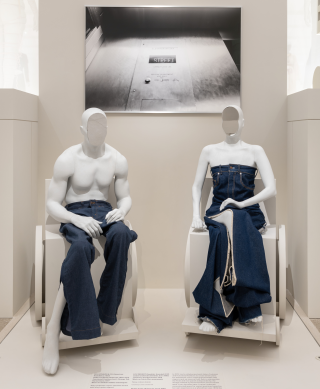
Cultural spaces have historically excluded the Disabled body, presenting a key opportunity for institutions and organisations to invest, partner, and collaborate to address these absences. A consistent barrier to diverse representation in fashion exhibitions has been the availability of mannequins representing different body types, along with the inflexibility of the mannequin-making process, which often restricts the poses and range available to curators when displaying garments on Disabled bodies. It was a priority for The Costume Institute that the mannequins in ‘Costume Art’ reflect the diversity of embodied experiences with fashion.
Additionally, the department expressed a desire to build upon its existing resources for volunteer guides to help ensure that they were confident and further equipped to discuss disability and support guests with varying access needs.
Our approach
Guided by The Costume Institute, Tilting the Lens applied a holistic approach to the project, utilising four of our core services, research, strategy, design, and training.
Research
To ensure the ‘Disabled Body’ section was as broad and representative as possible, Tilting the Lens researched design archives for disability-related collections and explored the lived experiences of Disabled designers. This research helped inform curatorial’s pairings of fashions with artworks from other Met departments, sparking new conversations about where Disabled bodies have historically been depicted in art.
Strategy
Tilting the Lens provided strategic framing for this section of the exhibition and catalogue, centring themes of Disability Rights, Disability Pride, and Disability Justice. The intentional naming of ‘Disabled Body’ was an exercise in reclamation, designed to challenge ableist euphemisms.
Design
Tilting the Lens participated in trialing an innovative photogrammetry casting process, which allowed diverse mannequins, including a new digital mannequin of Sinéad Burke, to be created for the exhibition. For this project, the ‘cast’ was done in a cylindrical machine, with 175 cameras placed three inches apart, covering the entire surface area. There was a space inside for the model to step into and every part of the body was captured in the centre of the lenses.
Training
In coordination with The Costume Institute and The Met’s Access team, Tilting the Lens designed and hosted a virtual training programme for the volunteer guides. The sessions covered the models of disability, the use of disability-first terminology, introductions to brief visual descriptions for Blind or low-vision guests, and practical scenarios for supporting visitors who may be over-stimulated or require a place to rest.
Testimonials
Outcome and impact
The ‘Costume Art’ exhibition successfully honours the beauty and validity of the Disabled body, communicating to visitors that disability is an inherent part of the human experience. Pieces by Disabled designers and artists including Justin LeBlanc, Helen Cookman, Lou Linderoth, Nolan Trowe, and Sugandha Gupta are included in the exhibition. The mannequins, which feature polished steel in place of faces, successfully allow visitors to see themselves reflected in the garments and diverse body types. A number of Disabled people’s bodies, including those of Aariana Rose Philip, Sonia Vera, Antwan Tolliver, and Aimee Mullins, are also represented in the exhibition.
A core principle at Tilting the Lens is building legacy memory so that accessibility remains part of an institution’s long-term fabric. To encourage future academic research into the ableism present in design systems, Sinéad Burke donated two garments to the Costume Institute’s permanent collection, ensuring that the Disabled experience remains an accessible resource for future scholars and designers.
The exhibit was profoundly emotional for me. Knowing that the mannequins were modeled on real Disabled people changed everything. It was not abstract. It was not symbolic. It was embodied. It was intimate. It felt like our bodies, so often misunderstood, hidden, corrected, medicalized, pitied, or treated as an inconvenience, were finally being given space, form, beauty, authority, and reverence. I felt enormous pride. Pride in you. Pride in us. Pride in the quiet, radical power of Disabled bodies being present in one of the most important cultural institutions in the world, not as tragedy, not as inspiration, not as an afterthought, but as design, history, politics, elegance, and truth.
(Exhibition visitor) Cara Yar Khan, Senior Advisor, Global Disability Innovation Hub
Further Reading

Reflection
Tilting the Lens and the Met – a story of accessibility and representation in ‘Costume Art’ (opens in a new tab)
A personal reflection from Sinéad and the team about the working on the project
The Met
Visit the Costume Art exhibition (opens in a new tab)
The exhibition runs until January 10, 2027 at The Metropolitan Museum of Art in New York

